Operating Table – How to Choose for the Operating Room
2 March 2026
Designing a modern operating room requires a series of well-informed technological decisions. One of the most critical elements of surgical equipment is the operating table, as it directly affects patient safety, surgical precision, and the working comfort of the operating team. The selection of an operating table should not be based solely on purchase price. In practice, it is a long-term investment that determines how efficiently and safely an operating room will function for many years.
Precision That Truly Supports Modern Surgery
Contemporary surgical procedures demand highly accurate patient positioning. This is particularly relevant in orthopaedic surgery, neurosurgery, and robot-assisted procedures, where even minimal deviations may influence surgical outcomes. For this reason, a modern operating table should provide exceptionally precise positioning, expressed in millimetres and fractions of a degree. Importantly, such levels of accuracy—reaching up to 0.5 mm and 0.1°—are no longer limited to fully electric systems. Advanced electro-hydraulic operating tables increasingly offer comparable precision, often at a significantly more budget-friendly level, while still meeting the demands of advanced surgical disciplines.
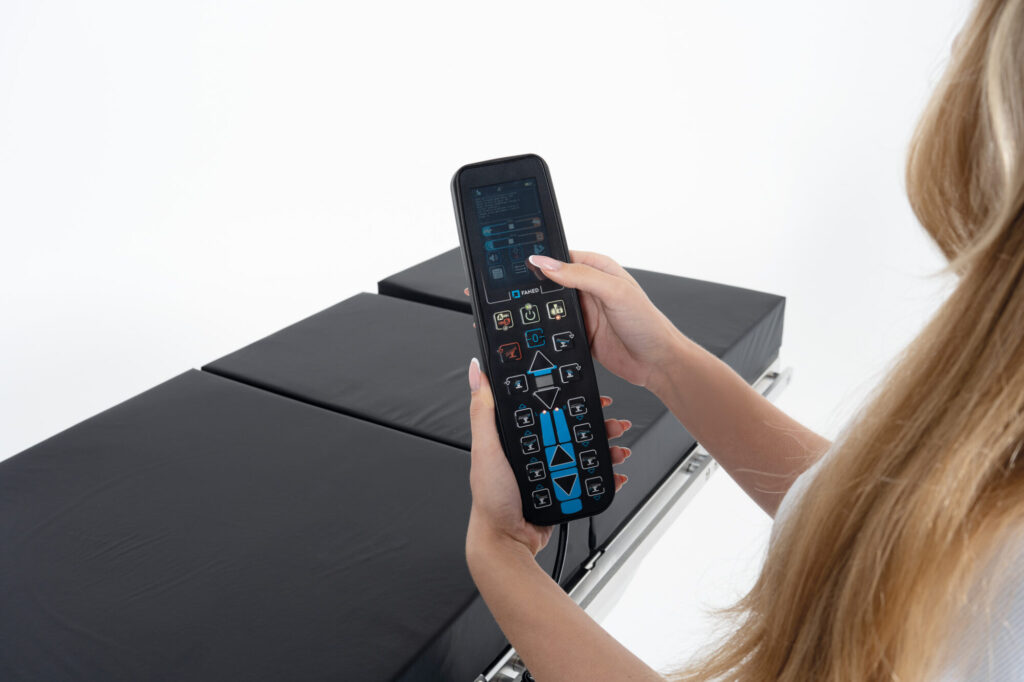
Ultra-precise control system used in Famed X-Line.
Ergonomics as a Factor of Patient Safety
Surgeon comfort is not a secondary consideration. During lengthy procedures, the ergonomics of the operating table have a direct impact on fatigue, concentration, and manual precision. A well-designed operating table allows the surgeon to work close to the operative field while maintaining a natural, stable posture. Adequate foot clearance around the table reduces the need for compensatory body positions, which in turn lowers the risk of musculoskeletal strain. Over time, improved ergonomics contribute not only to surgeon wellbeing but also to enhanced patient safety.
Compatibility with Intraoperative Imaging
Modern operating rooms increasingly rely on intraoperative imaging, particularly mobile X-ray systems such as C-arms. As a result, full compatibility between the operating table and imaging equipment has become essential. Key design considerations include a slim base, a low profile, and the absence of protruding structural elements that could interfere with imaging devices. High radiolucency and unobstructed access enable faster positioning and reduce the need for repeated adjustments, ultimately shortening procedure time and improving workflow efficiency.
Mobility and Flexibility in a Dynamic Surgical Environment
The number of devices used during surgical procedures continues to grow. Consequently, the operating room has become a highly dynamic space that often requires rapid reconfiguration. An operating table should therefore offer smooth and intuitive manoeuvrability. The use of multidirectional castors and precise steering mechanisms allows the table to be positioned easily without complex movements. This facilitates faster room turnover, simplifies cleaning and disinfection processes, and improves overall operational efficiency.
Control Systems and Operational Safety
Advanced control systems are now a standard feature of modern operating tables. These systems must deliver not only precise and repeatable movements, but also high levels of operational safety. Particular attention should be paid to solutions that ensure continuity of operation in emergency situations. Dual-drive or redundant actuation systems allow the table to remain functional even in the event of power failure or electronic malfunction, significantly increasing reliability within the operating room.
Durability and Hygiene as a Baseline Standard
Operating tables are subject to strict hygienic requirements and intensive daily use. Traditionally, stainless steel has been the absolute standard in operating table construction due to its corrosion resistance, mechanical durability, and ease of cleaning.
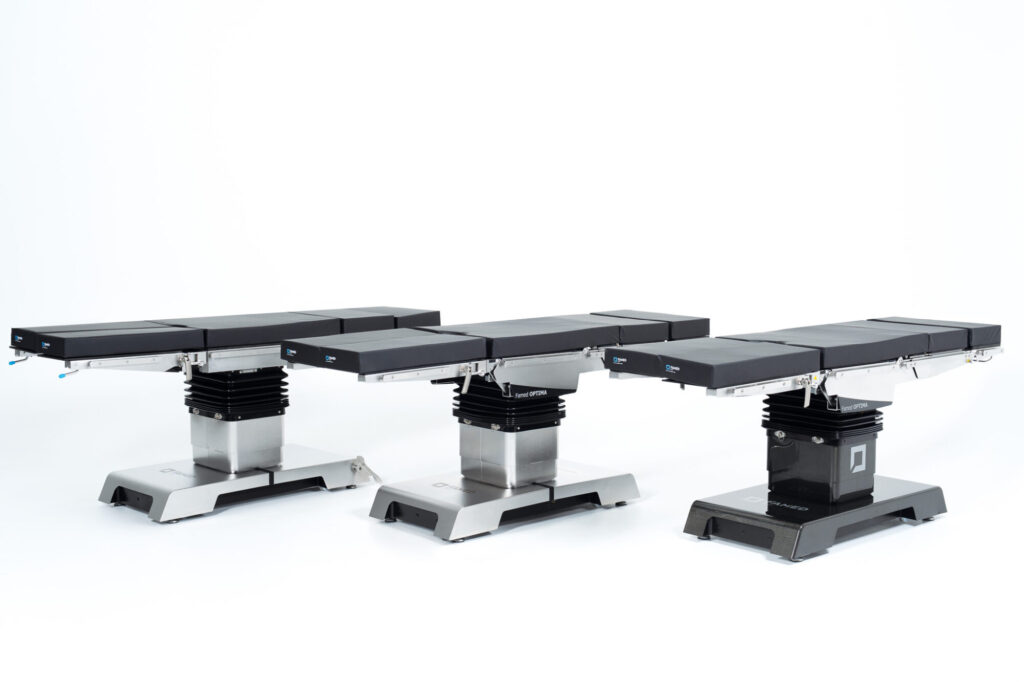
However, the market is gradually shifting towards more advanced structural solutions. Increasingly, manufacturers are introducing components made from carbon fibre composites. These materials combine high structural strength with lower weight and improved radiolucency, offering clear advantages for intraoperative imaging. As a result, composite-based designs are becoming more common in modern operating rooms.
Making an Informed Choice for the Modern Operating Room
Selecting an operating table is a decision that impacts the entire operating suite. Precision, ergonomics, imaging compatibility, mobility, and system safety should take priority over cost alone. Today’s market offers solutions that successfully combine high positioning accuracy with reasonable investment levels. This includes advanced electro-hydraulic operating tables capable of meeting the requirements of modern surgical practice. A well-chosen operating table effectively supports the surgical team. In the long term, it contributes directly to patient safety, procedural efficiency, and the overall performance of the operating room.


 Ultra-precise control system used in Famed X-Line.