How ICU beds support physiotherapy and accelerate patient recovery
26 June 2026
An intensive care unit is an environment where every piece of equipment matters. It affects patient safety, treatment effectiveness and the comfort of medical staff. A modern ICU hospital bed can provide real support in the treatment process and in daily patient care. From the perspective of physiotherapy, it becomes one of the key tools used by the medical team. It helps initiate early mobilisation, which, as studies confirm, may shorten recovery time and reduce the risk of complications [1,4,5,6,7]. Therefore, ICU beds and intensive care beds should support not only treatment, but also physiotherapy and the patient’s gradual return to functional independence.
The role of ICU beds in early mobilisation
Early mobilisation of ICU patients is one of the key elements of modern therapy. It helps reduce the risk of complications associated with prolonged immobilisation, such as pressure ulcers, pulmonary embolism and muscle atrophy. Moreover, starting rehabilitation during the first days of treatment in mechanically ventilated patients supports faster functional recovery and may reduce the number of days spent in delirium [4]. Today, patient movement is treated as an integral part of therapy: precisely planned, dosed and monitored [6]. In this context, an ICU bed is no longer just a piece of equipment. It becomes an active therapeutic tool. At the same time, it supports medical staff in carrying out gradual and safe patient mobilisation.
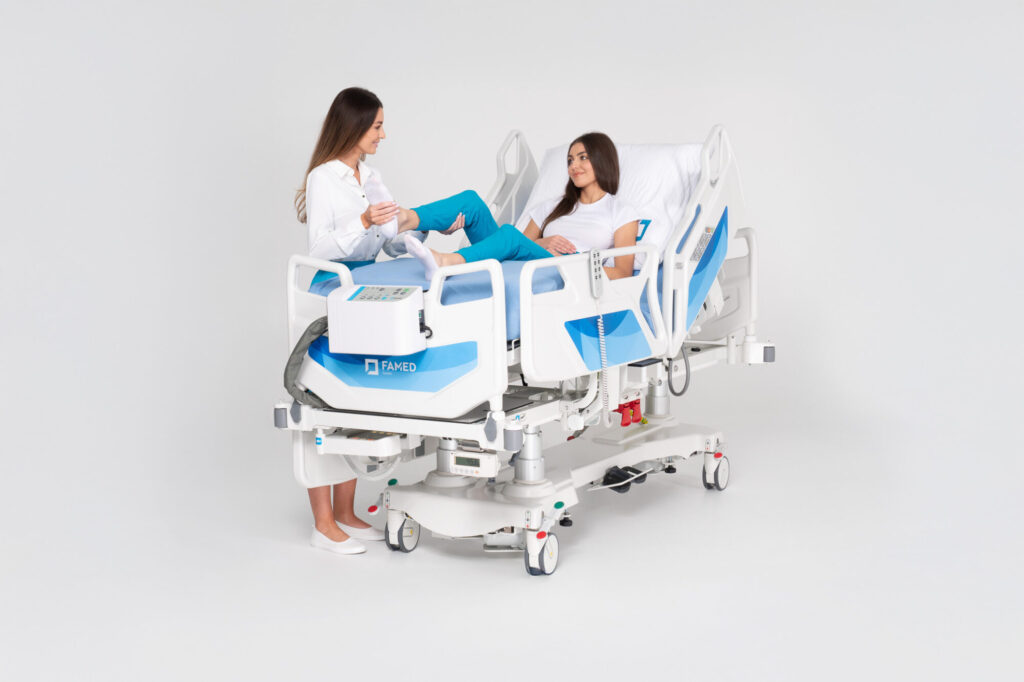
Modern Famed NOBILIS ICU bed supporting physiotherapy and early patient mobilisation.
Changing the patient’s position as part of physiotherapy in the ICU
From the perspective of physiotherapy, even a small change in patient positioning can be important. Moving from a lying position to a semi-sitting position, known as the Fowler position, with the lower limbs elevated, may improve the patient’s respiratory and circulatory functions. At the same time, ICU beds support patient activation and encourage active participation in therapy. This has both physiological and psychological significance. Modern intensive care beds enable smooth patient repositioning. This is supported by programmable functions and intuitive control panels. As a result, these solutions reduce the need to involve several staff members in a single task. Moreover, they improve the ergonomics of the medical team’s work and increase the effectiveness of therapy [1,2].
The chair position in ICU beds as a functional therapeutic base
The chair position, also known as the cardiac position, is one of the basic therapeutic positions used in the ICU. It facilitates breathing, supports circulation and improves patient comfort [2,6]. In this position, the patient regains a greater sense of control. They can communicate more easily with medical staff, express their needs or perform simple activities, such as reaching for water. This is highly important for the patient’s mental state and motivation for further rehabilitation. Proper back support, flexion at the hip and knee joints, and stable foot positioning facilitate both respiratory therapy and resistance exercises. In modern intensive care beds, the ability to programme this position and activate it with a single button allows the physiotherapist to focus on working with the patient rather than operating the equipment.
Therapeutic positions in ICU beds – overview and clinical application
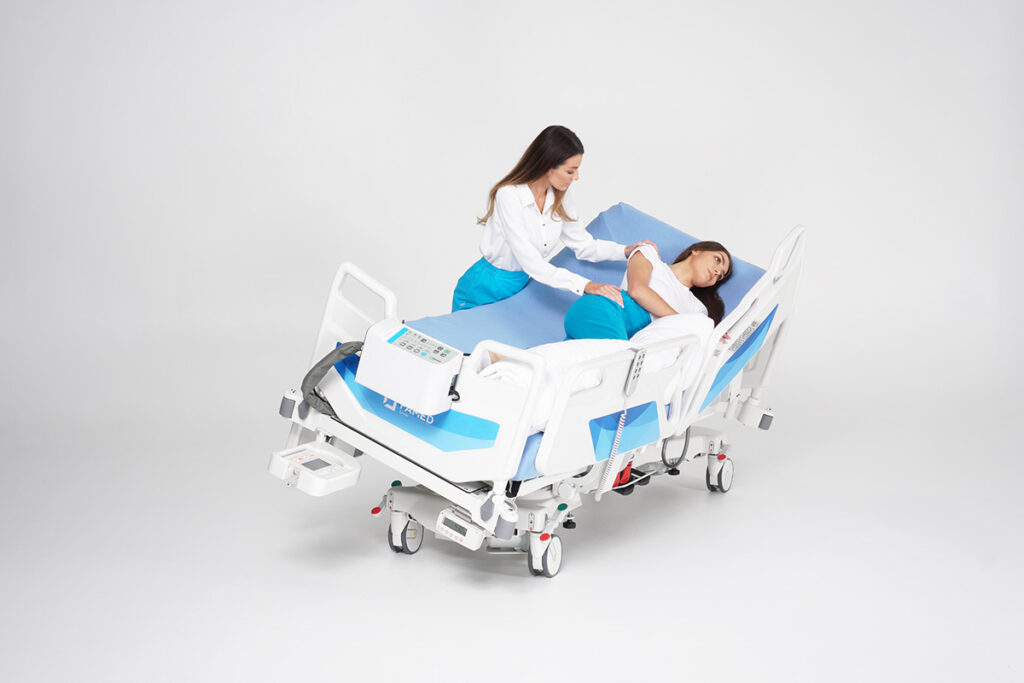
Modern ICU hospital beds make it possible to use a wide range of positioning options that support specific therapeutic goals. Their rapid adjustment, often available at the touch of a button, improves the efficiency of the medical team’s work. The most important positions include Trendelenburg and reverse Trendelenburg. They are used in positioning therapy and help support circulation and venous return. Lateral tilt also plays an important role, as it facilitates patient repositioning, supports postural drainage and assists with daily care. The use of lateral tilt allows the patient to be positioned safely in a way that provides full access to the back. Proper stabilisation helps keep the patient in a secure position. As a result, the physiotherapist or nurse can work with both hands, without having to support the patient’s body. In intensive care beds, these positions can be used gradually, in line with the principle of progressive mobilisation. At the same time, there is no need to transfer the patient to additional equipment [4].
ICU beds with lateral tilt supporting patient rehabilitation.
ICU beds – practical solutions
The World Health Organization emphasises that medical equipment should reduce the risk of errors and staff injuries. It should also support a culture of safety in healthcare [5]. One of the key elements affecting work ergonomics is the design of the ICU bed. Well-designed solutions can significantly reduce the physical workload of medical staff and improve the efficiency of daily patient care activities.
Structural elements supporting medical staff
Split side rails deserve particular attention. They increase patient safety, facilitate transfers and provide stable support. The option to remove the bed end or use a properly profiled bed end is also important. This solution makes it easier to reposition the patient and use rehabilitation equipment. During standing exercises, a stable foot-end panel plays an important role, as it allows the patient to brace themselves safely. Structural solutions that make it easier to manage medical cables are also significant. This is especially important for patients connected to multiple devices. These functions are complemented by a central wheel locking system. It allows the bed to be immobilised quickly and safely in the selected position [1,2]. Well-designed intensive care beds make it possible for many tasks to be performed by one person. This is important both for patient safety and for the efficiency of medical staff.
ICU beds – patient parameter monitoring and safety
Modern ICU beds increasingly support patient condition monitoring. As a result, an integrated scale makes it possible to monitor body weight without the need to transfer the patient [2]. In addition, safety-enhancing systems play an important role. These include alarms for lowered side rails and unlocked wheels. Such solutions are in line with recommendations for the prevention of adverse events in hospital care [1,2,3,5].
Summary – what to consider when choosing ICU beds
The choice of a bed for an intensive care unit has a direct impact on the course of treatment and patient rehabilitation. From the perspective of physiotherapy, key features include programmable therapeutic positions, a wide height adjustment range and the ability to set bed tilts. These functions allow medical staff to adapt the bed position to the patient’s current condition and stage of therapy. The ergonomic design of the side rails and bed ends is also important, as it supports the team’s work and improves patient safety. Monitoring and alarm systems are equally significant. They support patient condition monitoring and help reduce the risk of adverse events. Intuitive operation is also essential, as it enables staff to respond quickly in the dynamic environment of an intensive care unit. A properly selected ICU bed supports both patient safety and the efficiency of the entire therapeutic team. In practice, this means fewer equipment-related limitations and, as a result, greater focus on treatment, rehabilitation and the patient’s return to functional independence.
Sources:
[1] Famed Żywiec. Famed NOBILIS – Folder informacyjny. 2026.
[2] Famed Żywiec. Instrukcja obsługi LE-13 / Famed NOBILIS z funkcją ważenia. Wyd. 28.00, 2025.
[3] Hill A.-M. et al. Measuring falls events in acute hospitals. J Am Geriatr Soc. 2010; 58: 1347–1352.
[4] Schweickert W.D. et al. Early Physical and Occupational Therapy in Mechanically Ventilated, Critically Ill Patients. Lancet. 2009; 373(9678): 1874–1882.
[5] WHO. Globalny Plan Działań na rzecz Poprawy Bezpieczeństwa Pacjentów na lata 2021–2030. Genewa; 2021.
[6] Wczesna mobilizacja na OIOM-ie. Rehabilitacja w Praktyce. 2022. Dostęp online: https://rehabilitacjawpraktyce.pl/wczesna-mobilizacja-na-oiom-ie/ (dostęp marzec 2026)